The Always-On Culture: Why Your Phone Is Draining Your Brain
The exhaustion you feel is not a willpower problem. It is what happens to a nervous system that never gets the all-clear signal.

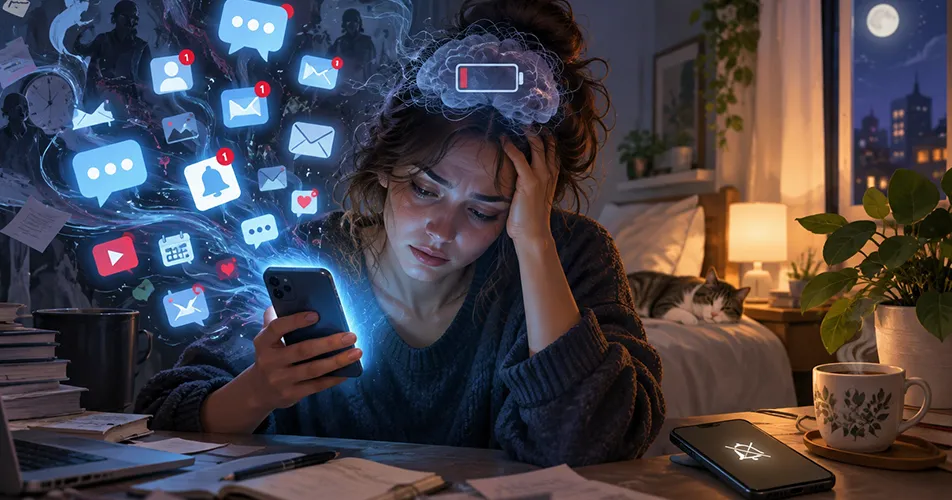
There is a particular kind of tiredness that has become remarkably common. It is not the tiredness of a hard day's work or a poor night's sleep, though it often arrives alongside both. It is a diffuse, low-grade depletion that people struggle to name. People sleep eight hours and still feel foggy. They cannot finish a chapter of a book, or a work email, or a conversation, without reaching for something. They are not exactly anxious about anything in particular, but they feel braced, as if waiting for a piece of bad news that has not arrived yet. And eventually many of them land on the same suspicion: I think my phone might be part of this.
That suspicion is usually well founded. Not because phones are evil, and not because the people holding them lack willpower, but because the modern smartphone is an extraordinarily effective device for keeping the human nervous system in a state of mild, continuous readiness. We were not built to be reachable every minute of every day, and we were certainly not built to be reachable by hundreds of people, applications, and algorithms at once. The exhaustion people describe is not a character flaw. It is a predictable physiological response to an environment that never issues an all-clear signal.
What "Baseline Anxiety" Actually Means
In clinical language, anxiety is often discussed in terms of episodes: a panic attack, a spike of worry before a presentation, a rush of dread when the phone rings with an unknown number. But most of what people describe when they talk about feeling "always on" is not an episode at all. It is a shift in the resting state, in what we might call the baseline.
Think of your nervous system as having a thermostat. When something threatening happens, the temperature rises: your heart rate increases, your attention narrows, stress hormones circulate, and your body prepares to respond. When the threat passes, the temperature is supposed to fall back down, and the recovery is the point. The stress response is not the problem; the stress response without a return to baseline is the problem. Chronic activation is what wears people down, because the body never gets the signal that it is safe to stand down and repair.
A smartphone in your pocket is, functionally, a small device that issues an unpredictable number of micro-alerts every hour that something in your world may require a response. Some of those alerts matter enormously: a child's school calling, a partner checking in, a job offer. Most do not. But your nervous system cannot know which is which until you look, and the not-knowing is precisely what keeps the thermostat elevated. Psychologists have long understood that unpredictable rewards and unpredictable demands are more arousing than predictable ones. A notification is both at once. It might be delight, it might be a demand, it might be nothing at all, and the only way to resolve the uncertainty is to check.
This is why so many people describe anxiety that has no clear content. They are not anxious about something; they are simply running warm. Over time, that elevated baseline shows up as irritability, difficulty concentrating, trouble falling asleep, a sense of being perpetually behind, and a strange restlessness during moments that used to feel restful.
Your attention does not wait for you to decide whether the notification is important. It leaves the moment the alert arrives, and it takes time to come back.
In one widely cited experiment, people who were interrupted only by the arrival of a notification, never touching or looking at their phones, performed significantly worse on a demanding attention task, and the disruption was comparable in magnitude to actually taking a call or answering a text. The buzz alone was enough.
The Cost Is Cumulative, Not Dramatic
One of the reasons people underestimate what their phones are doing to them is that no single instance feels like much. Glancing at a screen for four seconds is not a crisis. But a person who checks their phone dozens or hundreds of times a day is not experiencing one interruption; they are experiencing a fragmented day, and fragmentation has a cost that accumulates quietly.
The most compelling recent evidence comes from a randomized controlled trial in which 467 adults installed an application that blocked all mobile internet access on their smartphones for two weeks, while still allowing calls, text messages, and internet use on laptops and desktops. This was not a digital detox retreat and it was not deprivation of connection. Participants could still reach their people and still get their work done. The researchers simply removed the constant, ambient, in-your-pocket portal to the online world.
The results were striking. Blocking mobile internet improved mental health, subjective well-being, and objectively measured sustained attention, with ninety-one percent of participants improving on at least one of those three outcomes. In pooled analyses, the improvement in mental health symptoms was of a magnitude the authors noted was larger than the average meta-analytic effect of antidepressant medication in clinical trials, and the improvement in sustained attention was roughly equivalent to reversing ten years of normal age-related decline. This was a general community sample, not a clinical population, and nobody should read that comparison as a reason to stop a prescribed medication. But the finding is a serious one. It suggests that a meaningful portion of the fog and flatness many people carry is environmental rather than intrinsic.
Just as interesting was why it helped. When the researchers examined what changed, the benefits were partly explained by how people spent the reclaimed hours. Without mobile internet, participants spent more time socializing face to face, more time exercising, and more time outdoors. The phone had not simply been draining them; it had been quietly crowding out the exact activities that regulate mood and restore attention.
It is not the phone sitting on the desk that drains you. It is the live, unpredictable stream of demands the phone carries, and the habit of orienting to that stream.
Sleep Is Where the Damage Compounds
If there is one place where the always-on pattern does the most quiet harm, it is sleep. An updated systematic review and meta-analysis covering fifty-five studies and more than forty-one thousand participants across twenty countries found that electronic media use was consistently associated with poorer sleep quality and more sleep problems, with the strongest associations appearing for general smartphone use and for problematic internet use.
Clinically, this is where the pattern becomes self-reinforcing. An elevated baseline makes it harder to fall asleep, so people reach for the phone to distract themselves from the discomfort of lying awake. The phone provides stimulation and further activation, sleep is shortened and shallowed, and the next day the person wakes with fewer regulatory resources, less frustration tolerance, and a lower threshold for stress. Poor sleep raises anxiety, anxiety drives phone use, phone use degrades sleep. It is not a moral failing. It is a feedback loop, and feedback loops are broken by changing conditions, not by trying harder.
Why Deleting Everything Is Not the Answer
At this point, many people reach for the nuclear option. Delete the accounts. Buy a flip phone. Go dark for a month and come back reborn.
The impulse is understandable, but it is rarely the most effective plan, for two reasons. The first is that all-or-nothing plans tend to collapse, and their collapse teaches people that they are incapable of change, which is a far more expensive lesson than the original problem. The second reason is that the evidence simply does not support abstinence as the superior strategy.
A 2025 systematic review and meta-analysis pooled ten studies with 4,674 participants to test whether abstaining from social media improved affective well-being and life satisfaction. It did not. The researchers found no significant effect of social media abstinence on positive affect, negative affect, or life satisfaction, and the length of the abstinence period was unrelated to outcomes. Quitting, by itself, does not appear to make people happier.
An experimental study of 619 adults compared three groups: one that gave up smartphone use entirely for a week, one that simply reduced daily use by one hour, and a control group that changed nothing. Both interventions reduced problematic use tendencies, depressive symptoms, and anxiety symptoms, and both increased life satisfaction and physical activity. But the effects were generally stronger and more durable four months later in the reduction group than in the abstinence group. Less time on the phone improves well-being, and complete abstinence is not necessary.
Even the intuitive advice to simply turn off all notifications deserves a second look. A preregistered randomized controlled trial of 205 participants tested a one-week notification-disabling intervention using objectively logged phone data. Turning notifications off did not reduce screen time or checking frequency, and it actually increased fear of missing out, although participants did report that their phone use felt more intentional and less automatic. Silence without a plan can create its own anxiety. If you remove the alerts but keep the underlying uncertainty about what you might be missing, some people simply check more, and feel worse while doing it.
The goal is not less phone for its own sake. The goal is a nervous system that gets to come back down to baseline several times a day, and a set of habits that make checking a decision rather than a reflex.
Practical Boundaries That Actually Hold
What follows is not a purity test, and you do not need to adopt all of it. People tend to do best when they choose two or three changes, practice them for a few weeks until they are automatic, and only then consider adding more. The aim throughout is to create predictable windows of non-availability, because predictability is what allows the body to stand down.
Protect the first and last hour of the day
The two most valuable boundaries you can build are the hour after you wake and the hour before you sleep. The morning check sets your baseline arousal for the day before you have had any chance to establish your own agenda; the evening check does its damage to sleep onset and sleep quality. Buy an inexpensive alarm clock, charge the phone in another room or across the bedroom, and let the first thing your brain processes each day be something other than other people's demands.
Batch your inputs instead of eliminating them
Rather than either constant alerts or total silence, a randomized field experiment found that delivering notifications in predictable batches three times a day left participants feeling more attentive, more productive, in a better mood, and more in control of their phones, with lower stress and fewer interruptions. Notably, participants who received no notifications at all reaped few of those benefits and reported higher anxiety and greater fear of missing out. Predictability, not deprivation, is the active ingredient. Use scheduled summaries or focus modes so that your phone gathers the noise and hands it to you at times you choose.
Triage your alerts into three tiers
Decide which people and applications may interrupt you at any moment, which may reach you during batch windows, and which you will visit only when you deliberately open them. For most people the first tier is very short: immediate family, a child's school, an on-call rotation. Everything else can wait an hour without consequence. Make this decision once, in a calm moment, so that you are not renegotiating it a hundred times a day while tired.
Make the friction work for you
Move the most magnetic applications off your home screen and into a folder, or log out so that reopening requires a password. Turn on grayscale for the evening. Leave the phone in a drawer during dinner. None of this is about making the phone impossible to use; it is about inserting a two-second pause between the impulse and the action, which is often all the space a person needs to notice that they did not actually want to be scrolling.
Create device-free places rather than device-free hours
People tend to succeed with spatial rules more than temporal ones, because a rule about a room does not require ongoing willpower. The bedroom and the dinner table are the two highest-yield choices. A phone left face-down on the table during a conversation is a signal, to both parties, that attention is divided; the research literature on "phubbing" links this pattern to lower relationship satisfaction, higher stress, and poorer sleep.
Replace, do not simply subtract
This is the piece people skip, and it is the piece the research suggests matters most, because the benefits of reduced phone access are partly explained by what participants do instead: they are with people, they move their bodies, they go outside. If you take twenty minutes away from your phone and give it to nothing at all, you will feel restless and you will relapse. Decide in advance what the replacement is. A walk. A phone call to an actual human voice. Ten pages of a book. The dog.
Keep the parts that genuinely serve you
Social media is not uniformly harmful, and for many people, particularly those who are isolated, disabled, far from family, or part of a community that is hard to find locally, it is a genuine source of connection and support. The meta-analytic evidence that quitting does not reliably improve well-being should be reassuring here. You are allowed to keep the group chat with your college friends and the account that makes you laugh. What you are changing is the involuntary, ambient, all-hours quality of the relationship, not the relationship itself.
Expect the first week to feel worse
When the input stops, the baseline arousal does not immediately drop; often people notice their anxiety more clearly because it is no longer being masked by stimulation. This is a normal and temporary part of the process, and it is also why the notification-disabling study found an increase in fear of missing out. Knowing it is coming makes it much easier to sit through.
When It Is More Than Habit
There is a line worth naming. For a substantial number of people, phone use has moved past habit and into a pattern that meets the criteria researchers describe as problematic smartphone use, with recent scoping reviews estimating a global pooled prevalence of roughly thirty-seven percent, with meaningful associations to anxiety, depression, and impaired functioning.
If you have tried to cut back repeatedly and cannot, if your phone use is damaging your work or your relationships, if you feel genuine distress when you are separated from your device, or if the anxiety underneath the checking is severe enough that it interferes with your daily life, that is not a discipline problem and it will not be solved by an app timer. It is worth a conversation with a mental health professional. Anxiety disorders, attention difficulties, depression, and trauma histories all interact with compulsive checking in ways that are very treatable once they are identified, and treatment tends to work better and faster than another round of self-blame. At STMHA, our clinicians provide individual psychotherapy and, when appropriate, medication management for anxiety and attention concerns that no amount of screen-time settings can fully address.
The exhaustion so many people are carrying right now is real, it is physiological, and it is largely a response to an environment rather than evidence of some personal deficiency. You are not weak because a device engineered by thousands of very smart people to capture your attention has, in fact, captured your attention. What you are owed, and what your nervous system requires, are regular intervals in which nothing is asking anything of you. Not silence forever. Just enough predictable quiet, several times a day, for the thermostat to fall back to where it belongs.
If you are having thoughts of suicide or self-harm, call or text 988 to reach the Suicide and Crisis Lifeline, available twenty-four hours a day, seven days a week. If you are in immediate danger, call 911.
A companion piece worth pairing with this one is How to Tell the Difference Between Stress, Anxiety, and Burnout. If the depletion in this article resonates, that article helps clarify which underlying state is actually driving it, and what tends to help in each case.
References and Further Reading
- National Institute of Mental Health (NIMH). Anxiety Disorders.
- American Psychological Association. Sleep and Mental Health.
- Centers for Disease Control and Prevention (CDC). About Sleep.
Ready to Get Off the Treadmill?
South Texas Mental Health Associates offers therapy and psychiatric care for adults in Corpus Christi, Edinburg, and across South Texas navigating anxiety, attention difficulties, and the depletion of modern life. When better boundaries are not enough, a conversation with a licensed professional is the next step.
Become a Patient